
Transmission: ‘Control’, Communication, and the End of Ian Curtis
Originally published Nov 7, 2023. Written by Kian Jepson.

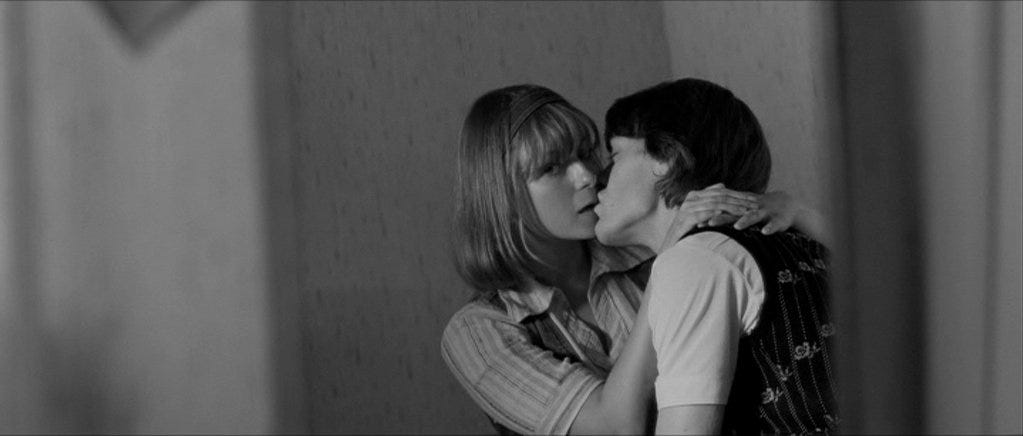
‘I love you.’
‘What do you mean?’
The 2007 film Control centres on the life and death of Joy Division lead singer Ian Curtis. In this meander through strange cinema, Control may itself seem a strange choice. At first glance, it is a music biopic that goes through a portion of childhood, the rise to fame, and the decline of a famous musician. Quelle Surprise. However, Control is rooted within weirdness, which it depicts as a product of communication – or lack thereof.
Ian Curtis, it must be noted at the outset, was no saint. Whilst legions of Unknown Pleasures t-shirt wearing fans have knelt before the altar and kissed his foot proclaiming him a genius of unknown proportions, he was an abusive and manipulative husband. Control fails to place enough emphasis on Curtis’ abuse. Curtis’ obsession with controlling his wife Debbie is somewhat glossed over, with one or two lines in the nearly two-hour film disposing of the issue. Curtis’ suicide at 23 turned him into a martyr, his reputation underwent a metamorphosis that it did not deserve.
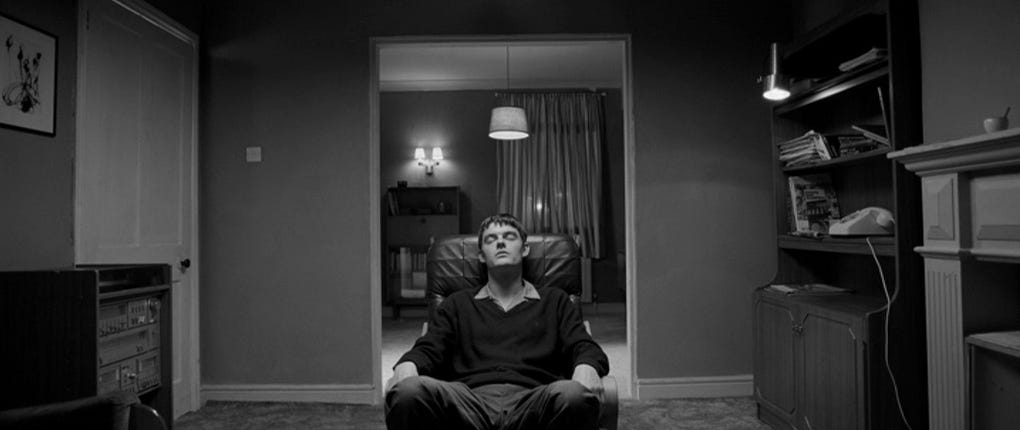
The film begins with Curtis in his schoolboy days at the King’s School in Macclesfield, then a grammar school. Curtis arrives home and is greeted by his father, he walks into his room, silent and unresponsive, takes his sister’s fur jacket and lies in his bed listening to Bowie and smoking. Not a single word is said by Curtis during the opening scenes. Lads asking for their football back are ignored, Curtis’ father is blanked. The music plays to a silent room, with a man seemingly non-existent to the world laying beside the turntable. When he does venture out to spend time at an old people’s home as part of his school’s social service programme, he is compelled to steal any drugs he can find in the medical cabinet – a habit, as we learn from the biography this film is based on, that led to an overdose and a stomach pump at the age of 16.
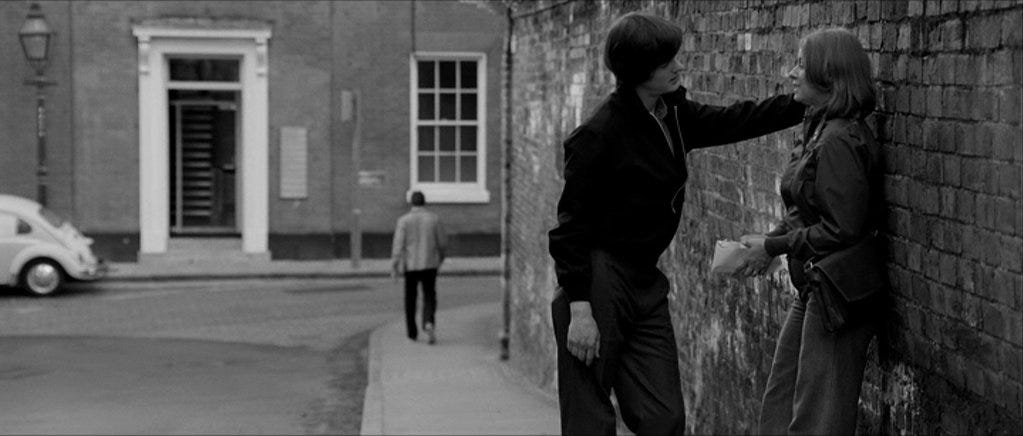
So, what then distinguishes this film from the boilerplate music biopic? The easy answer is that Curtis died at 23. He did not live long enough for there to be narrative material to fit the standard rise-fall-rise again arc. There are no cheesy montages of recording and touring and recording and touring and recording ad infinitum until the eventual burnout and drug habit and low point and rediscovery of spirit and recording the comeback album or going to rehab or sorting themselves out whatever-the-fuck-way they do. But the key theme of the film and the biography of Ian Curtis’ life is that it is fraught with mis- and non-communication.This crux is what creates the strangeness of the film, there is no absurdity in the picture between some inherent element of the film which is inconsistent with itself or with the outside world of cinema or the wider world, instead the weirdness is within the disjointedness of the characters of the film themselves.
Emiloid has published a detailed video essay on the instances in which the film illustrates this abject failure to communicate However, whilst Emiloid believes that the band were (perhaps wilfully) ignorant of the personal significance contained in Curtis’s – the only means for him to truly communicate his feelings with the world – in favour of focusing on the music they produced, I disagree. The band didn’t see Ian as communicating full stop. When the enigmatic, lanky, Manc lad shut himself off from the world, the world didn’t realise when he tried to open up. The biography makes a point early on of showing that Curtis wasn’t the dour, morose character he is often perceived as: he could be upbeat and funny and charming. But it does not shy away from the fact that nobody seemed all too surprised when he died. This feels, instinctively, wrong – how can you know that someone would die and fail to reach out when they attempted the only method of communication they thought possible? The natural push and pull of these positions represents that fundamental conceit, the fundamental oddity of the film.
The band looked at Ian’s lyrics with awe, but never thought that they could be about Ian. Instead, they have admitted that they were impressed with how clever Ian could be that he could so convincingly inhabit the perspective of others. Sometimes it was literal, as when he wrote She’s Lost Control (inspiring the name of the film) about a girl with epilepsy that Ian met when he worked for the Department of Employment, who later died as a result of her disorder. But the song is just as much about Ian’s fear of his own condition, the epilepsy that he too suffered, and its almost literal representation of the isolation from the world that he began to experience.
“And she showed up all the errors and mistakes and said, ‘I’ve lost control again.”
The ‘errors and mistakes’ may here represent the deep-seated anxiety and isolation Curtis felt throughout his life – the enigma of his personality is not a trait, it is the struggle. The film simulates a few epileptic seizures, first in the classroom when Ian seems to have an absence seizure in a chemistry lesson. The first tonic-clonic (grand mal) seizure happens in the car on the way home from a terrible gig in London where Ian is trying to take a sleeping bag off the gravely ill Bernard Sumner because he is ‘fucking freezing’. The next happens on stage after Curtis’ idiosyncratic dancing, sending him crashing into a cymbal before being dragged off stage into the green room. The final one happens the night before his suicide.After having drank heavily and argued with Deborah, he collapses in a seizure on the floor. In the film the instances of seizure represent and align with the moments that he is the most isolated, the most afraid and the most unable to communicate. In the car, he is physically unable to get across not only the pain and annoyance of being cold, but the disappointment of the gig and the exhaustion at the triple life he is leading between his work, his family, and his band. On stage, his expression in his body and his words is the only true moment of openness and honesty, but the band keep on playing, oblivious to the struggle and the torment believing that he was just a clever lad talking about someone else. Even when he seizes, the band keep going – in the isolation of the seizure and the isolation of his life just passing by unnoticed by those around him, even the seizures cannot communicate to those around him. The final seizure is after his failure to recover his marriage in light of his long standing affair with Honoré and his consistent mistreatment of Deborah. He cannot communicate the love he has for his family – perhaps he himself does not understand it. When Deborah gives birth the first thing Curtis does is leave for a cigarette. Alone. He has hardly looked his daughter in the face before he has gone, he does not talk to his wife after the life-changing event she has just been through. He leaves. He stays alone.
These pleasure’s a wayward distraction. This is my one lucky prize, Isolation.
Curtis refuses joy to withdraw into isolation. He cannot exist on a level with the world. His inability to communicate creates an absurdity between his position and those inhabiting the world around him.
‘I love you’.
‘What do you mean?’.
Even this cannot be expressed. Ian does not love Deborah, truly. He manipulates and mistreats her. He carries on an affair and lies to Deborah about it. He tries to communicate some feeling to her, but it is wrong. What do you mean?
The inability to communicate is a fundamental hallmark of oddness. We define normality by what we understand to be normal through our lens of social and economic expectations, and when somebody fits outside of that, understanding begins to fade away. In the last column I expressed that to take the aesthetic hallmarks of cult films and strip them of any moral transgression creates a disturbing absurdity. But here there is no disjoint between aspects of the film (such as the aesthetic/moral quandary), there is fundamental disjointedness between people. Talking without talking. Nothing goes between anyone in this film. Curtis exists outside the understanding of the people he is surrounded by, and the absurdity of his position lies in his existence as a heroic figure on the stage, but the complete isolation of Ian Curtis no matter how many people he is surrounded by.
Student Film Journal | Nov 7, 2023
For more articles all about film, please consider subscribing.